- Guides, tutorials and docs
- Learning the Woovebox
- The very basics
- Quick start tutorial and video
- Tempo and BPM
- Tracks
- Patterns
- Live pattern recording
- Conditional triggering and modification
- Chords
- Arpeggios
- Scales and modes
- Genres
- Patches and Presets
- Sound design
- Paraphonic parts
- Multi-instrument mode
- Risers, fallers, sweeps & ear candy
- Live mode
- Song mode
- Full song writing
- Sampler & vocoder
- Sidechaining, gating, ducking and compression
- Mastering
- Lo-fi & vintage analog and digital emulation
- Randomization
- Hall effect sensor playing
- Advanced techniques
- Undo
- Boot modes
- MIDI, Sync and connecting other gear
- Remote control expander mode
- Wireless MIDI over Bluetooth
- Battery and charging
- Hardware quirks and limitations
- Understanding DSP load
- Looking after your Woovebox
- Firmware updates
- Quick start tutorial and video
- Program a kick drum
Program a kick drum
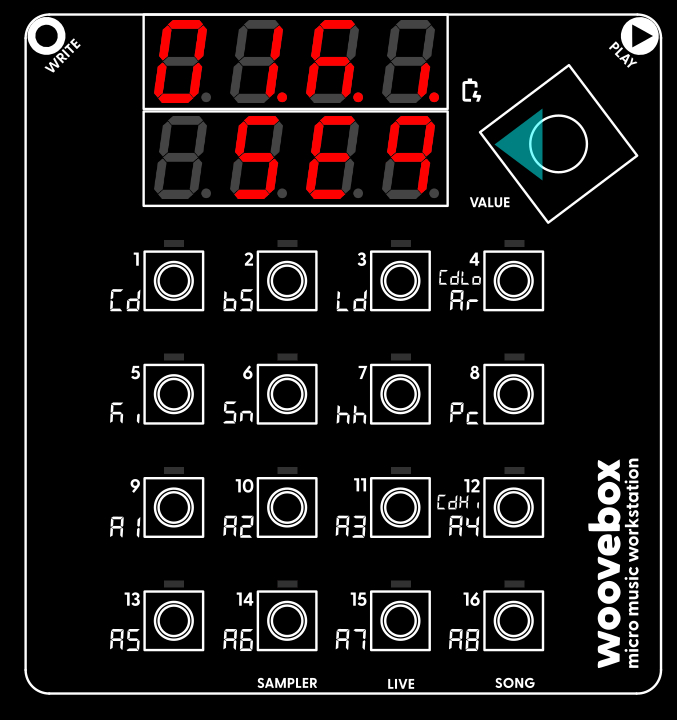
Make sure you're on the sequencer page ("Seq" ) of the kick track's pattern 01 ("01.Ki SEq"). The sequencer ("SEq") page is where events (notes, chords, sample triggers) are added, edited or deleted.
Press play to start playing our empty kick drum track pattern. You will hear nothing right now, but while playing, you will see a blinking "play head" to indicate the position, running from left to right, top to bottom. As your Woovebox steps through the pattern, any steps that the play head encounters that contain programmed kick drum (LED lit up) are played back. Any steps that do not contain a kick drum (LED off) are ignored at that moment in time. Press play again to stop playback.
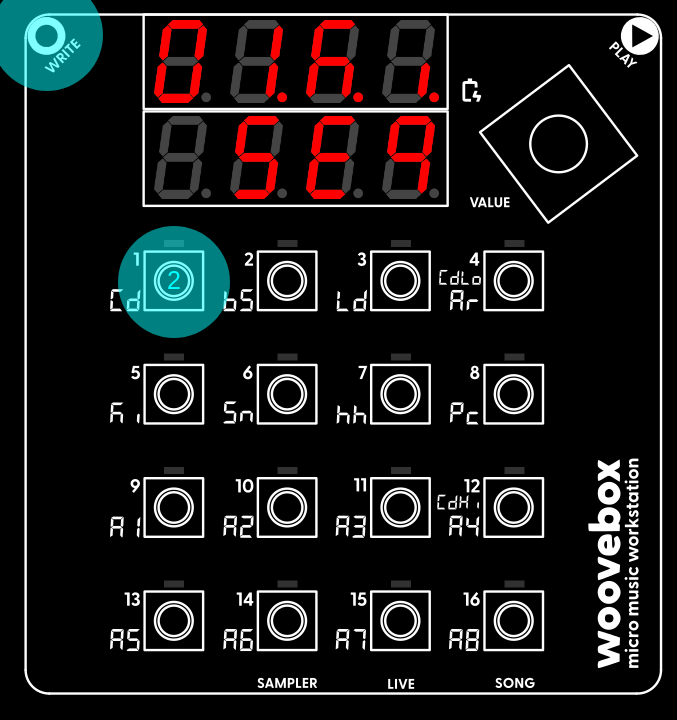
Right now, no kick drums are recorded at all, so playing the pattern back will not produce any sound; let's change that. Program a simple four-to-the floor pattern like so;
- Press any of the 1-16 keys to audition the kick drum you want to program. Depending on the selected kick drum patch, the kick drum may sound different depending on the key you press.
- Once you auditioned a kick drum you like;
- hold write and short-press key 1
- still holding write, short-press key 5
- still holding write, short-press key 9
- and still holding write, short-press key 13.
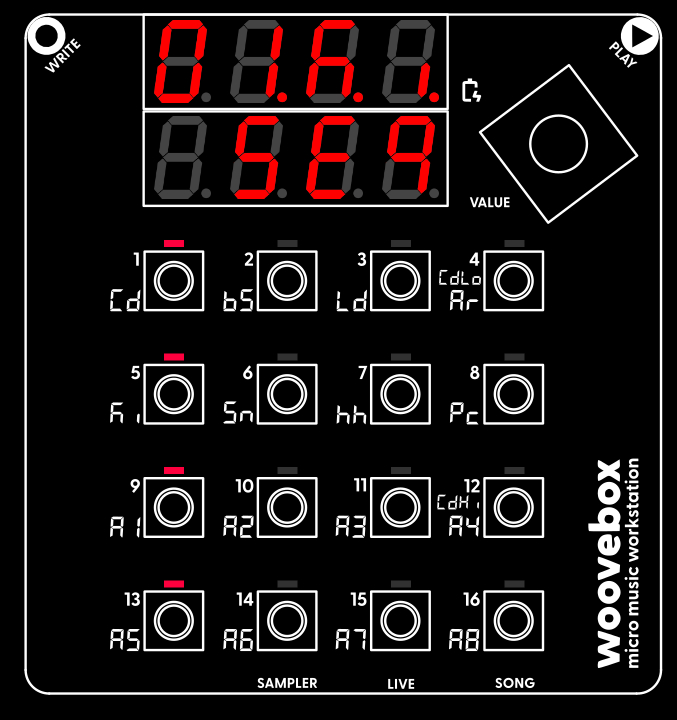
You have now programmed your chosen kick drum sound onto steps 1, 5, 9 and 13; a standard "four-to-the-floor" pattern.
If you made a mistake and wish to delete a kick drum from a step, simply hold write and short-press the key corresponding to the step (LED lit up) you wish to clear (LED no longer lit up).
Now press play to hear your kick drum pattern being played back to you. Press play again to stop the playback. You may have also noticed that pressing play caused your song to be automatically saved ("SAVE xxx", where xxx is the current battery level %).
Feel free, of course, to add or remove kick drums as you please.
Using the randomizer
If you lack inspiration or need to get something going quickly, your Woovebox comes with an "intelligent" randomization feature. On the "SEq" page, choose and action the "rand Pttn" context menu option. Your Woovebox will now create a random pattern that fits the intended behavior ("bEhv" under 7/hh on the track's "Glob" page) of the track. In this case it will provide you with a plausible kick pattern, but in case of other track behaviors, it will provide you with chords, melodies, basslines, etc. as appropriate. For more information, see the randomization section.
You may also be interested in...
- Example (under Sidechaining)
- Create and apply sample kit patch (under Amen chop tutorial)
Select and action the "make sample kit patch" functionality ("Pach Kit") from the context menu.
- 16 x 16 x 16 x 16 (under The very basics)
Many other devices swap this, and often give you a number of tracks per pattern.
- Full preset list (under Patches and Presets)
saw stab; pure saw patch, good starting point for sound design.
- Song Mode; where the full experience comes together (under Full song writing)
Going back and forth between song mode and track (pattern creation / sequencer) mode.
- Guides, tutorials and docs
- Learning the Woovebox
- The very basics
- Quick start tutorial and video
- Tempo and BPM
- Tracks
- Patterns
- Live pattern recording
- Conditional triggering and modification
- Chords
- Arpeggios
- Scales and modes
- Genres
- Patches and Presets
- Sound design
- Paraphonic parts
- Multi-instrument mode
- Risers, fallers, sweeps & ear candy
- Live mode
- Song mode
- Full song writing
- Sampler & vocoder
- Sidechaining, gating, ducking and compression
- Mastering
- Lo-fi & vintage analog and digital emulation
- Randomization
- Hall effect sensor playing
- Advanced techniques
- Undo
- Boot modes
- MIDI, Sync and connecting other gear
- Remote control expander mode
- Wireless MIDI over Bluetooth
- Battery and charging
- Hardware quirks and limitations
- Understanding DSP load
- Looking after your Woovebox
- Firmware updates