- Guides, tutorials and docs
- Learning the Woovebox
- The very basics
- Quick start tutorial and video
- Tempo and BPM
- Tracks
- Patterns
- Live pattern recording
- Conditional triggering and modification
- Chords
- Arpeggios
- Scales and modes
- Genres
- Patches and Presets
- Sound design
- Paraphonic parts
- Multi-instrument mode
- Risers, fallers, sweeps & ear candy
- Live mode
- Song mode
- Full song writing
- Sampler & vocoder
- Sidechaining, gating, ducking and compression
- Mastering
- Lo-fi & vintage analog and digital emulation
- Randomization
- Hall effect sensor playing
- Advanced techniques
- Undo
- Boot modes
- MIDI, Sync and connecting other gear
- Remote control expander mode
- Wireless MIDI over Bluetooth
- Battery and charging
- Hardware quirks and limitations
- Understanding DSP load
- Looking after your Woovebox
- Firmware updates
- Performing with Live mode
- Live jamming
Live jamming
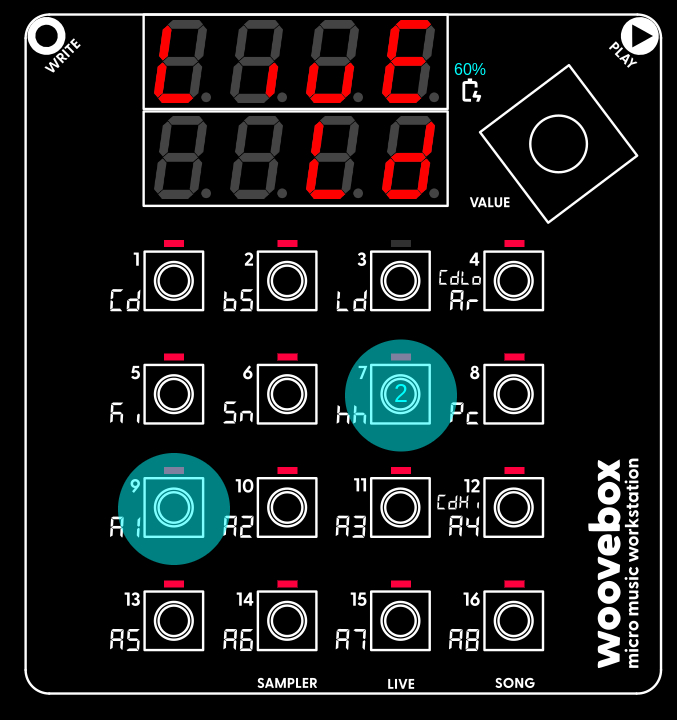
Despite its limitations, the Woovebox keyboard can be surprisingly expressive and very much suitable for live playing and improvising complex melodies.
Combined with legato, you can even dynamically create pitch glides; hold 1-16, then quickly play another 1-16 to slide from the first held 1-16 pitch to the second played 1-16 pitch. Note that to use glides, the patch needs to be configured to allow this. You can configure your patch on the 'Pich' (pitch) page; set Live Glide (LLGL) under 3/Ld to 'on'. Then set Legato Speed (LEG.S) under 7/hh to a value other than 0 to control the glide speed.
The way the keyboard translates key presses into note pitches, depends on how the FLW.C (follow chord) parameter on the 'Glob' (global) page is configured for your patch. For example, key presses may be automatically "pulled" toward the root note of the chord that is currently playing, or key presses may be automatically translated to the "legal" notes of the musical scale for your song. Please refer to the documentation to learn more about all the different modes at your disposal.
You may also be interested in...
- "What Is Love" (remake) song SYX (under Example songs and patches .SYX files)
The track makes liberal use of overlapping notes + legato for the voice line approximations.
- Restoring patches (under Wooveconnect)
You do not have to be on the patch ("PAch") page for that track.
- Patches and presets (under Guides, tutorials and docs)
chord bass note transpose (in case of a chord preset).
- Switch to the kick drum track (under Quick start tutorial and video)
There is a convenient shortcut to the "Seq" page; on any page other than the "Seq" page, short-press the value knob.
- 8. Sd.rL Sidechain Release (under Dynamics)
Specifies how slow/fast sidechaining should end for this track.
- Guides, tutorials and docs
- Learning the Woovebox
- The very basics
- Quick start tutorial and video
- Tempo and BPM
- Tracks
- Patterns
- Live pattern recording
- Conditional triggering and modification
- Chords
- Arpeggios
- Scales and modes
- Genres
- Patches and Presets
- Sound design
- Paraphonic parts
- Multi-instrument mode
- Risers, fallers, sweeps & ear candy
- Live mode
- Song mode
- Full song writing
- Sampler & vocoder
- Sidechaining, gating, ducking and compression
- Mastering
- Lo-fi & vintage analog and digital emulation
- Randomization
- Hall effect sensor playing
- Advanced techniques
- Undo
- Boot modes
- MIDI, Sync and connecting other gear
- Remote control expander mode
- Wireless MIDI over Bluetooth
- Battery and charging
- Hardware quirks and limitations
- Understanding DSP load
- Looking after your Woovebox
- Firmware updates